Back to home

Educational guide

Bauhaus Inspiration

From art to play, from play to art

A guide by Vincent Ramlot, Luxiol

Following the trainings given by Céline Alvarez in 2018 and 2019 in Namur, many teachers wanted Grimm’s material for their classrooms. At Luxiol the material had already been on the shelves for several years, and its creative power was undeniable.

For over a year we travelled across Brussels and Wallonia with our bag full of Grimm’s material, so teachers could watch their pupils at play.

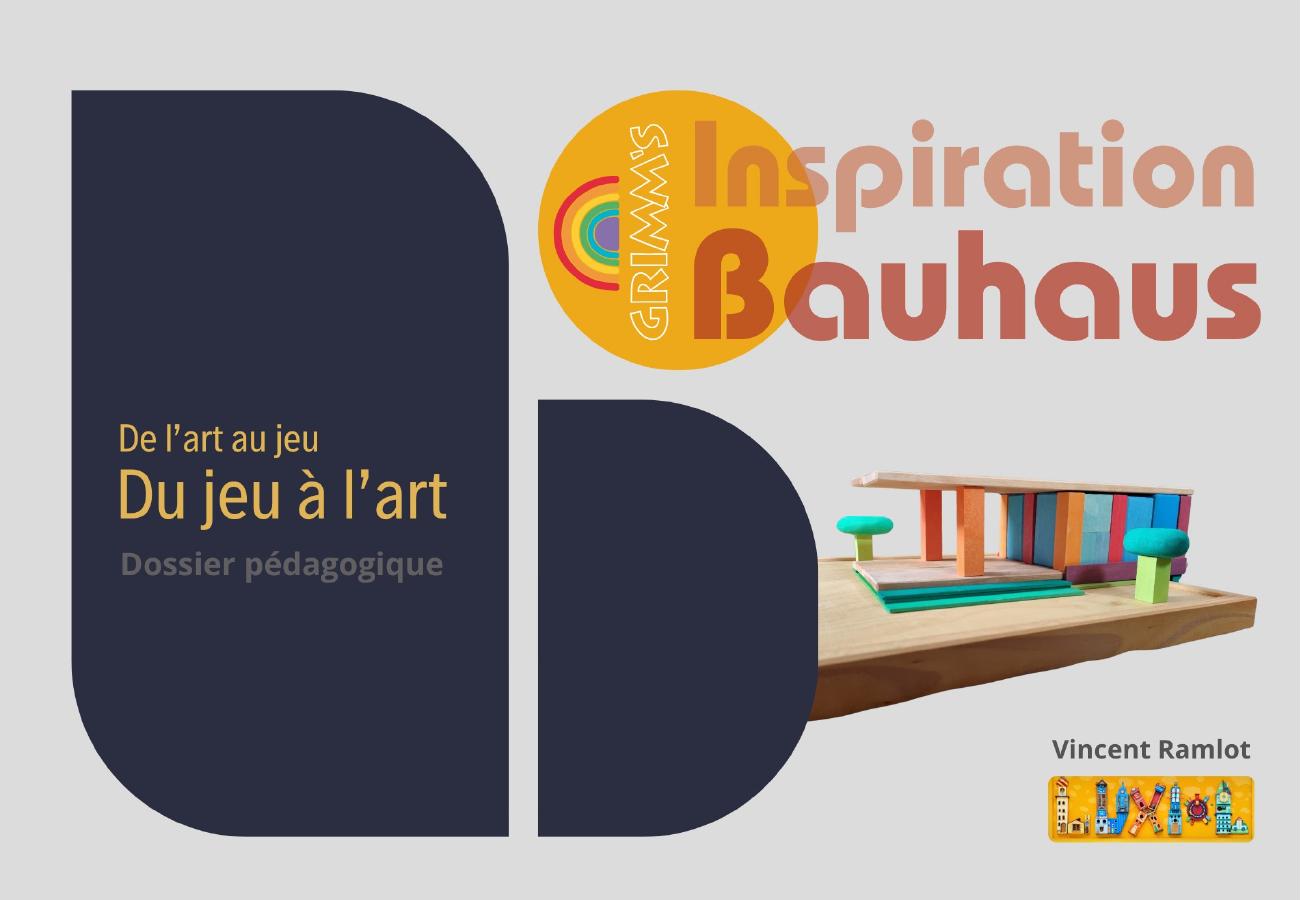
Cover of the Bauhaus Inspiration educational guide, from art to play, from play to art

Our approach in a few words

Free play

No instructions, no goal. The adult observes, listens and plays alongside the child.

Grimm’s

Colourful wooden building material whose creative power needs nothing added.

Creativity

Perseverance, trial and error, concentration, dialogue, cooperation and pleasure.

The Bauhaus

Colours, lines and shapes: an artistic and educational legacy running through play.

What we observed

A year of Grimm’s workshops

At first we had planned many instructions and challenges. We quickly realised that the Grimm’s material alone was far more powerful than any activity we had designed.

Little by little the instructions focused on living together, caring for the material and tidying up, and no longer on the discovery time itself. We let go and took an observing stance: listening, playing with the children, welcoming their words and stories without judgement.

Free play

Children know what they are doing: they are playing. They reveal themselves simply by being themselves. There is nothing to teach here; their creativity is awake, along with perseverance, trial and error, concentration, dialogue, cooperation, verbalisation and, above all, pleasure.

“The aim is that there is no aim”: freedom is born from there, a virtuous circle.

Questions

Where does the power of this material come from? How can children be so certain of their approach without instructions? What makes them so proud of their constructions? Why are their creations always aesthetically striking?

Colour is a decisive element. Lines and shapes guide the intention to build upwards or flat, side by side or stacked, as if the power of play itself gave rise to the wish to express an inner world.

From the Bauhaus to Grimm’s

The link with the De Stijl and Bauhaus movements soon became clear. The guide draws a parallel between Grimm’s toys and the Bauhaus school: its workshops, its revolutionary organisation, its new pedagogies, its concepts, its architecture and furniture, and the emblematic works of its teachers.

It also looks at Alma Siedhoff Buscher, Bauhaus artist and designer and a cornerstone of the world of play, whose 1923 Schiffbauspiel leads straight to today’s construction toys.

An artistic approach

The guide proposes an artistic learning situation built around phases and actions: imagine, perceive, interpret, create, then review, share, present and argue.

It ends with six inspiring workshops, to be adapted at home, at school, in after school activities or in therapy settings.

« Every child is an artist. The problem is how to remain an artist once we grow up. »

Pablo Picasso

The educational guide

The full guide is available in French and English, free to download.

Discover the material in the shop

Grimm’s material can be freely handled at Luxiol before any purchase. Come and try it.

Visit us

Chaussée d’Ixelles 221 · 1050 Ixelles